Finding the Truth: How AI Search Systems Verify Information Before They Cite It
 Milivoje Krivokapic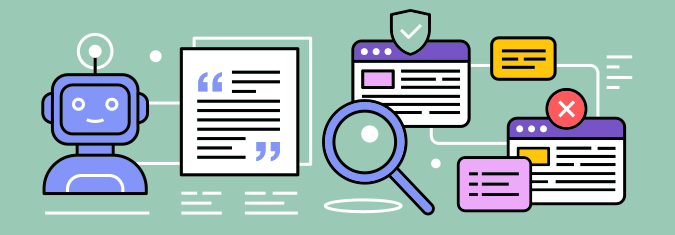
Six in ten people say AI-generated answers are clearer and more useful than traditional search results. Yet, based on the same research, 85% of them still double-check what they read elsewhere. That says a lot about where search is right now.
AI feels confident, even too confident sometimes. We’ve all seen answers that sound right, read smoothly, and still miss the mark. That’s why the question isn’t just how AI answers questions, but whether it checks itself before repeating what it finds.
The short answer is: yes. Modern AI search systems don’t pull a page and quote it blindly. They retrieve information first, then decide whether it’s safe to reuse. That decision happens before a source ever shows up in an answer.
That’s the part most people don’t know. Finding information is easy, but deciding whether it’s safe to repeat is the hard part.
Why “Being Right” Is No Longer Enough
For a long time, accuracy was the goal. If your content was correct, detailed, and well-written, it had a shot at visibility.
That logic breaks down with the rise of AI-generated answers. AI systems don’t struggle to find correct information, but to decide what can be repeated without introducing risk. A claim can be accurate and still fail that test.
The problem is isolation. A fact that appears once, explained in one way, has nothing to lean on. There’s no supporting context, no second signal to confirm it holds up elsewhere.
Conflicting explanations make things worse. When two sources describe the same idea differently, AI systems hesitate because the system can’t be sure which version to reuse.
Citation depends on confidence. If an explanation can’t be restated clearly and consistently, it stays out of the answer.
Retrieval Vs. Verification: What’s the Difference?
Most people assume AI works like a faster search engine. It finds a page, pulls an answer, and moves on. That’s not how modern systems operate.
Retrieval is the first step. The system scans its index, pulls relevant documents, and extracts fragments that seem related to the question. At this stage, nothing is trusted yet. The system is collecting candidates, not facts.
Verification happens after that. This is where the system slows down and evaluates what it found. It looks for overlap, consistency, and agreement across sources, checking whether the same idea shows up elsewhere in a similar form.
This is why AI-generated answers don’t simply reflect the best single page. Retrieval is mechanical, and verification is interpretive. The one gathers information, and the other decides whether it’s safe to reuse.
Consistency: the First Trust Filter
Once the information has been retrieved, the next question is: Does this idea hold up anywhere else?
Consistency is the first signal AI systems look for when deciding whether something can be reused. It sits at the center of how AI answers questions at scale. A claim that appears once, even if it’s accurate, offers no backup. There’s nothing to confirm that the explanation isn’t an outlier.
When the same idea shows up across multiple sources, explained in similar terms, uncertainty drops. The value comes from shared meaning, not copied language.
That’s why phrasing and framing matter. Two pages can describe the same concept using different words and still align. But if the structure of the explanation changes, or the meaning shifts, trust weakens.
A single excellent article can explain a concept perfectly. But five average, focused articles explaining the same idea give AI systems far more confidence when deciding what to reuse.
Corroboration: Strengthening Claims Across Independent Sources
Consistency is a start, but it isn’t enough on its own. The next question is: where does that consistency come from?
AI systems pay close attention to independence. It’s a key part of how AI answers questions when deciding what information to repeat with confidence. When the same explanation appears across unrelated sources, certainty rises. When it shows up across pages that clearly reference each other, it doesn’t.
Corroboration means agreement across different publishers, platforms, or formats, telling the system that an idea isn’t confined to one corner of the web, but has broader support.
Authority still plays a role, but it no longer carries the weight it once did. A well-known site repeating a claim inconsistently creates more doubt than several smaller sources explaining it the same way.
Does Semantic Alignment Beat Factual Accuracy?
Even when sources agree, AI systems still look closer. The question shifts from is this correct to does this mean the same thing everywhere it appears.
Semantic alignment is about shared understanding. Two sources can state the same fact and still conflict if they define it differently, frame it in different contexts, or imply different outcomes. That mismatch introduces risk.
This is where AI-generated answers often filter things out. If one page treats a concept as a general rule and another treats it as a narrow exception, the system may hit the brakes. The real question is whether that explanation can be reused without distortion.
Language plays a quiet role here. Clear definitions, stable terminology, and confident explanations are easier to restate. Vague wording or shifting meanings make reuse harder.
How Entity Stability Makes Citation Possible
When meaning aligns across sources, AI systems still need something to hold it in place. That’s the job for entities.
Entities give information a stable reference point: A company, a concept, a product, a person. They’re central to how AI answers questions when it tries to understand what a source is actually talking about. When those entities are described the same way across sites, explanations become easier to verify and reuse.
Problems start when entity descriptions drift. One source frames a brand as a category leader, another treats it as a niche player, and a third barely defines it at all. Even if each page is accurate on its own, the system sees uncertainty.
Stable entity descriptions reduce that risk. They tell AI systems that the same thing is being discussed, in the same context, and with the same role, making it safer to pull an explanation into an answer.
This is why citation favors alignment over optimization. Clear, repeatable entity definitions travel further than clever positioning ever will.
Let Verification Happen Before Visibility
AI search has changed what it means to show up. Visibility no longer starts with ranking, but with reuse.
AI-generated answers don’t pull in information because it exists or because it’s polished. They reuse what feels stable, what holds together across sources, and what can be repeated without introducing doubt.
That’s why being right isn’t the finish line. Consistency, corroboration, semantic alignment, and stable entity definitions decide whether information survives the verification process.
At Zlurad, we work on those verification layers. Not by chasing rankings, but by helping brands align how they’re described, understood, and reinforced across the sources AI systems rely on.
Our goal is simple: Make your meaning easy to verify before it ever needs to rank. Because when meaning aligns, reuse becomes possible.