Query-Less Discovery: How People Find Brands Without Searching At All
 Milivoje Krivokapic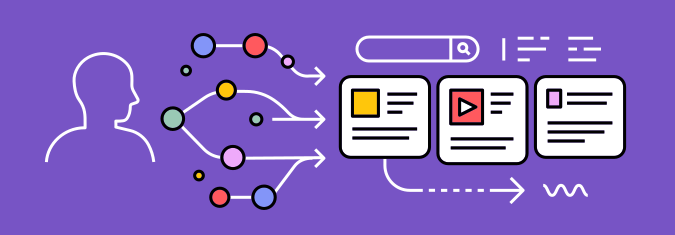
As of late 2025, zero-click searches are estimated to account for roughly 60 percent of all Google activity. Most discovery now ends before anyone visits a website.
That number matters, but not because clicks disappeared. It matters because it reflects how people actually get answers. Information surfaces early, often before a question is fully formed, and decisions begin to take shape without an intentional search ever happening.
You see it in small, familiar moments. An answer appears while you’re still thinking, or a suggestion shows up while you’re writing, planning, or comparing options. The system doesn’t wait for a query. It anticipates what might be useful and places it in front of you.
This is what zero-click searches look like in practice. Relevance is surfaced through context, behavior, and patterns, not through carefully typed keywords.
This creates a real problem for brands. When visibility depends on being selected before a search happens, classic optimization logic starts to fall apart.
Let’s check how discovery works in the times when no clicks are needed to get the answer you asked for.
From Searching to Being Shown
Discovery doesn’t require a deliberate action. Many of the moments where people bump into brands now happen while they are already doing something else.
Instead of asking, systems surface options when intent is implied rather than expressed, without a single keyword being typed. This is why zero-click searches feel so effortless for users. The system removes barriers by stepping in early, often before a decision is fully formed.
What changes is control. Users still choose, but the range of options is narrowed before they actively search. Being visible in these moments means being relevant early, not just accurate later.
This is a big challenge for brands. Visibility isn’t responding to demand anymore, but being present when demand is still taking shape.
What Triggers Discovery Without a Query
When no search is happening, something else has to indicate intent. Those cues usually come from behavior rather than language.
These signals are often subtle on their own, but powerful when combined.
Common triggers include:
- Recent actions, such as pages viewed, tools used, or content engaged with
- Contextual cues like time, location, or device
- Ongoing tasks, workflows, or conversations
- Aggregated behavior from similar users in similar situations
Zero-click searches don’t begin with a question, but with a probability. The system estimates what is likely to be useful and surfaces it before the user asks. If your content only makes sense in response to a clearly stated query, it may never enter these discovery moments at all.
How Relevance Is Decided Without Keywords
When keywords disappear, relevance doesn’t. It just gets evaluated differently.
Instead of matching a phrase, systems look for meaning. They try to understand what a piece of content is about, how consistently that idea is expressed, and whether it reliably applies to a situation where intent is implied rather than stated.
Several signals tend to matter more than individual terms:
- Conceptual focus, where one clear idea is carried across a page or section
- Consistent language that reinforces meaning instead of fragmenting it
- A structure that makes relationships between ideas easy to follow
- Contextual value, meaning the content fits naturally into a moment of need
This changes what “optimization” really means. Zero-click searches favor content that can be lifted, summarized, or referenced without explanation. If the meaning only emerges after reading everything, it arrives too late.
What You Need to Change to Win Clickless Searches
Zero-click searches reward quality over quantity. When discovery happens early, systems need to understand what you offer without relying on a perfectly phrased query.
A few changes matter most.
Shift From Query Targeting to Intent Coverage
Content should address a problem space, not just one phrasing of it. When systems infer intent, they look for coverage, not precision.
Anchor Each Page To a Single, Clear Idea
Pages that try to do too much become harder to classify. One dominant concept gives systems a reliable signal.
Use Structure To Carry Meaning
Headings, ordering, and emphasis help systems understand how ideas relate. Structure reduces ambiguity when content is surfaced out of context.
Write For Easy Extraction
Content should make sense when picked, summarized, or cited. If meaning depends on everything around it, it won’t travel far in zero-click searches.
When relevance is easy to recognize, visibility follows more naturally. You don’t need to chase every new surface, but to be understandable wherever discovery happens.
Measuring Visibility When Searches Don’t Happen
The issue is that most teams still look for proof in places that no longer capture early discovery. When a brand is surfaced before a query exists, there’s often no visit to track and no clean attribution trail to follow. That doesn’t mean nothing happened. It means the signal shows up differently.
What Still Holds Up
Some signals remain reliable, even when discovery happens without clicks. They don’t tell the full story on their own, but together they reveal where relevance is forming. That includes:
- Impression-level visibility: Being shown inside summaries, suggestions, or generated answers matters, even when no click follows. Presence signals relevance before action.
- Topic-level coverage: Patterns emerge when a brand appears consistently around the same themes. Over time, this shows where you’re being considered, even without traffic spikes.
- Brand recognition effects: Early exposure shapes later decisions. A brand surfaced quietly today often feels familiar when a direct choice happens later.
What Breaks Down
Other metrics lose reliability once discovery shifts earlier in the journey. They still exist, but they no longer reflect influence accurately. Here are some of them:
- Clicks as the primary proof of value: Many zero-click searches end the journey before a visit ever happens, so clicks underrepresent influence.
- Rankings viewed without context: A position on a results page matters less when selection happens inside summaries or recommendations.
- Traffic used as a stand-in for relevance: Traffic reflects completed journeys, not early exposure. By the time a visit happens, discovery has already done its work.
Brands that adapt don’t chase perfect attribution. They read signals together and judge visibility by consistency, not immediate response.
How to Stay Visible When No One Searches
Zero-click searches change where discovery happens, but they don’t change what earns trust. Relevance still comes from relevance, consistency, and content that holds its meaning when it’s chosen early and out of context.
Brands that show up in these moments aren’t guessing what systems want. They’re making it easy to understand who they’re for, what they solve, and when they matter. That’s what allows relevance to travel ahead of intent.
At Zlurad, we help brands build content and structure that modern discovery systems can recognize, reuse, and cite, even when no query is typed and no click follows. Not by chasing trends, but by making relevance spread across search, AI, and emerging discovery surfaces.
Because when discovery moves earlier, strategy has to move with it.