Contradictory Information and AI Visibility: What Brands Need to Know
 Milivoje Krivokapic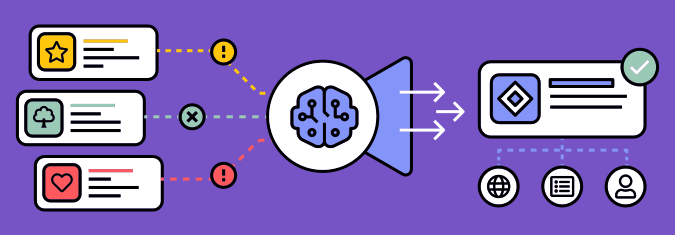
People have always had to deal with conflicting information. One source says one thing, another says the opposite, and somewhere in between, we try to figure out what’s accurate enough to trust.
Now, AI systems increasingly participate in that process.
When someone asks ChatGPT, Google AI Overviews, or Perplexity a question, the system still has to produce a coherent answer, even when the sources behind it don’t fully agree. That’s why discussions around how AI engines decide which sources to cite have become more important. These systems compare and synthesize information across multiple contexts, not just a single page.
That creates a challenge for brands.
As AI-mediated discovery grows, visibility is increasingly shaped by how easily a brand can be interpreted under uncertainty. This doesn’t mean your messaging should sound robotic or identical everywhere. But it does mean ambiguity, conflicting claims, and shifting positioning can make synthesis harder when systems try to generate clear answers from multiple sources.
What Happens When Sources Disagree?
AI systems generate answers by retrieving and synthesizing information from multiple sources. In many cases, those sources overlap. In many others, they don’t.
A company might describe itself as an “AI assistant” on its homepage, a “workflow automation platform” in product documentation, and an “enterprise search engine” in a founder interview. None of those descriptions is necessarily wrong. But they don’t point to the exact same interpretation either.
When systems encounter conflicting or loosely connected descriptions, they still have to produce a coherent answer. That’s also part of how AI engines decide which sources to cite, summarize, or rely on more heavily across generated responses.
This matters because AI citations don’t simply mirror traditional rankings. Ahrefs found that only 38% of pages cited in Google AI Overviews also ranked in the top 10 for the same query.
This doesn’t mean AI systems reject variation or expect perfect consistency. Brands evolve, messaging changes, and different audiences require different framing. But when terminology shifts too far across channels, interpretation becomes less stable.
Are Contradiction, Ambiguity, and Positioning the Same Thing?
When brands struggle with AI visibility, the problem usually isn’t a single misleading sentence. More often, it’s a pattern that makes the company harder to interpret consistently across sources.
That pattern usually falls into one of three categories.
What Happens When Your Brand Makes Conflicting Claims?
Contradiction happens when different sources make directly incompatible statements.
For example, a company may position itself as “built for startups” on one page while describing itself as an “enterprise-only solution” somewhere else. Both claims create very different expectations about the audience, pricing, and product scope.
When AI systems pull the information from multiple contexts, contradictions make it harder to determine which interpretation should carry more weight when multiple sources shape how AI engines decide which sources to cite in generated answers.
What Happens When Your Positioning Sounds Impressive but Means Very Little?
Ambiguity happens when positioning stays too abstract to communicate a stable meaning.
Phrases like “next-generation AI acceleration platform” may sound sophisticated, but they don’t clearly explain what the company actually does. Humans can sometimes infer meaning from the surrounding context. AI systems have a harder time grounding vague language into a specific category or capability.
That uncertainty matters when generated answers rely on concise summaries and contextual alignment.
What Happens When Your Brand Description Keeps Changing?
Positioning drift happens when a company gradually describes itself differently across channels and time.
A SaaS platform may begin as a “project management tool,” later shift toward “AI workflow automation,” and eventually frame itself as a “knowledge infrastructure layer.” Again, none of these descriptions is necessarily false. But if the transition isn’t reinforced consistently across supporting content and third-party sources, interpretation becomes less stable.
And when systems compare multiple descriptions at once, stable patterns are generally easier to synthesize than constantly shifting ones.
Why AI Systems Often Prefer Narrower, Scoped Claims
Broad positioning statements are harder to interpret consistently, especially when AI systems compare them with surrounding sources.
A phrase like “we transform digital intelligence” leaves a lot open to interpretation. It sounds ambitious, but it doesn’t clearly define what the company does, who it serves, or where its expertise begins and ends.
Now compare that to: “We help SaaS teams structure content for AI retrieval systems.”
The second statement is narrower, but also easier to contextualize. That matters because how AI engines decide which sources to cite often depends on whether information can be interpreted consistently across related contexts.
This doesn’t mean brands should strip away personality or sound overly functional. Strong positioning still matters. Storytelling still matters. But clear foundational definitions reduce interpretive uncertainty when systems synthesize information from multiple contexts.
How Brands Can Reduce Ambiguity Without Sounding Robotic
Brands don’t need perfectly identical messaging across every channel. But they do need a stable interpretive center that AI systems can consistently associate with the company.
That usually starts with a few foundational habits.
Start With a Definition You Can Defend Everywhere
Your core positioning should stay recognizable across your homepage, product pages, social profiles, and third-party mentions.
If your company describes itself differently in every context, interpretation becomes less stable when AI systems synthesize information from multiple sources.
Keep Core Terminology Stable Across Channels
You don’t need to repeat the exact same sentences everywhere. But foundational terms should remain consistent.
For example, if you describe your platform as “workflow automation software,” avoid switching to completely different category labels every few pages unless the distinction is clearly explained.
Make Broad Positioning Easier to Interpret
Ambitious messaging works better when it’s grounded in something concrete.
“We improve enterprise operations with AI” becomes easier to interpret when it’s followed by a clear explanation of how, for whom, and in what context.
Let Supporting Content Reinforce the Same Identity
Case studies, documentation, interviews, and educational content should strengthen the same general interpretation of the brand.
AI systems often compare information across multiple contexts. Reinforced patterns are easier to synthesize than isolated claims, especially when multiple sources influence how AI engines decide which sources to cite and summarize information.
Avoid Abstract Language Without Context
Terms like “intelligence layer” or “digital acceleration platform” may sound impressive, but they rarely explain enough on their own.
Specificity doesn’t weaken positioning. In many cases, it makes the brand easier to recognize, contextualize, and reuse across AI-generated responses.
Clarity Is Becoming Infrastructure
As AI systems increasingly mediate discovery, brands are no longer represented only by what they publish on a single page. They’re interpreted through patterns that emerge across websites, profiles, reviews, documentation, interviews, and third-party sources.
That’s why stable positioning matters more than ever, because coherent interpretations are easier to synthesize from fragmented information.
When your messaging stays grounded, scoped, and recognizable across contexts, your brand becomes easier to interpret, which can influence how AI engines decide which sources to cite in generated answers.
This shift doesn’t require brands to sound generic or overly controlled. It requires them to communicate with enough precision that both humans and AI systems can understand what the company actually is, what it does, and where its expertise fits.
At Zlurad, we help brands build content systems that stay interpretable across search, retrieval, and AI-driven discovery. Because when it comes to generated answers, visibility starts long before citation.
It starts with interpretation.